A Clockwork Orange: Exploring the Ethics of The Ludovico Technique
"A Clockwork Orange" a dystopian novel by Anthony Burgess published in 1962. It follows Alex, a teenage delinquent, who revels in crime and disorder with his gang, called the Droogs. After his arrest, he undergoes an experimental programme called The Ludovico Technique. This brutal experiment is used to condition him against committing violence and crimes, essentially stripping him of his free will. The story explores themes of free will, the nature of evil, and the impact of societal control, ultimately questioning the morality of using technology to enforce conformity.

---
Now lets dive deeper into A Clockwork Orange!
INTRODUCTION:

Title: A Clockwork Orange
Author: Anthony Burgess
Publication Date: 1962
Genre: Dystopian, Science and Psychological Fiction
Setting:
Time: A time in the near future
Place: Dystopian England
Key Locations: Municipal Flat Block 18a and Korova Milkbar
Character Breakdown:

Alex :
Protagonist and Narrator
A teenage delinquent
Part of a gang, The Droogs
Revels in "ultra-violence"
Deep love for Classical Music
Undergoes The Ludovico Technique
F. Alexander:
A writer
Lives in the cottage called HOME - Alex and his gang break into it
The gang murders his wife
Unknowingly takes Alex in and helps him
Writing a book "A Clockwork Orange" - Piece of writing against Reclamation Therapy
He ends up imprisoned after finding out about Alex

Dim:
Part of Alex's gang
Simple-minded and physically strong
Betrays Alex
Ends up as a policeman
Pete:
Part of Alex's gang
The most even-tempered member of the gang
In the end, he has a wife and a tame lifestyle
Georgie:
Part of Alex's gang
Has ambitions in leading the gang
Killed later on whilst Alex is in prison
Billyboy:
The leader of a rival gang
Later becomes a policeman with Dim
The Prison Chaplain:
Cleric
Takes a liking to Alex whilst he is in prison
Disturbed by Reclamation Therapy
The Minister of the Interior:
High ranking government official
Champion of Reclamation Therapy
A figure of authority
Themes:
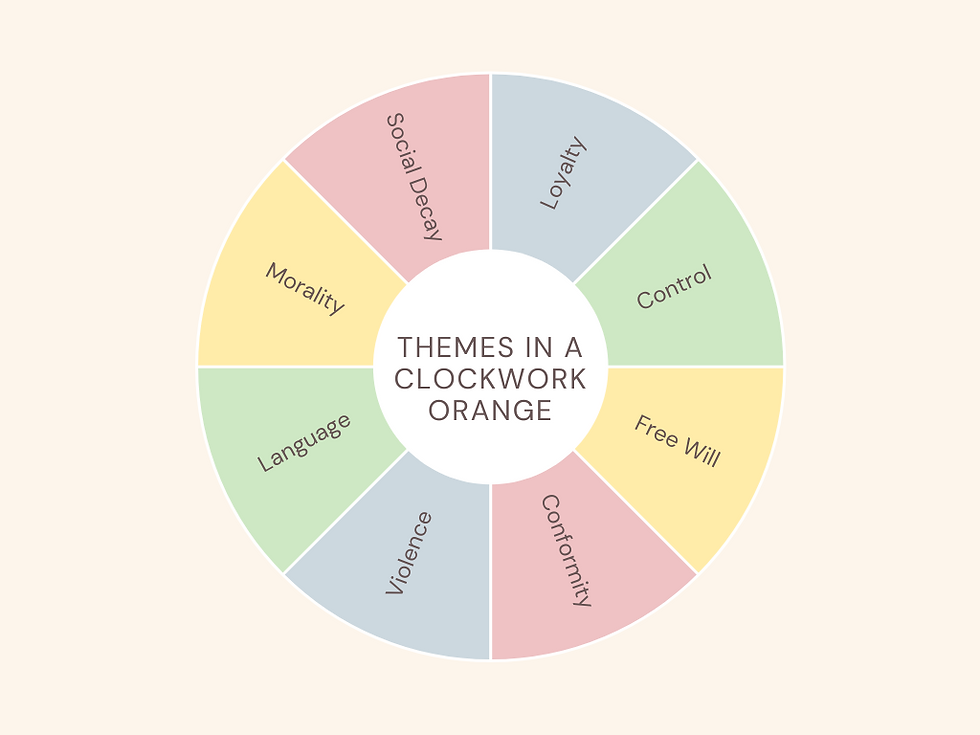
Here is a list of main themes:
The Power of Language
Free Will vs Conformity
Violence and Morality
Societal Decay
Loyalty
Now let's take a closer look at each...
Theme: The Power of Language
Definition: The Power of Language explores how language shapes identity, influences behaviour, and reflects society. Burgess introduces Nadsat, fictional slang, to suggest how language both empowers and alienates people.
Main points:
Manipulation and Control
Violence and language
Alienation
Examples in the text:
Nadsat: Barrier between the youth and older generation. Generational divides.
Descriptive Language: The descriptive language juxtaposes the brutal violent acts.
"What's it going to be then, eh?": Repeated phrase throughout. Explores both choice and identity through language.
Important Quotes:
"What's it going to be then, eh?"
"You back to here and now whimpering sort of, with all your rot all squaring up for a boohoohoo." (example of the Nadsat language)
Theme: Free Will vs Conformity
Definition: The theme of Free Will vs Conformity explores the tension between personal choice versus societal pressure to conform. It suggests the dangers of losing personal freedom.
Main Points:
Societal Pressure
Personal Rebellion
Consequences Against Rebellion
Examples in the text:
Alex's Rebellion and Violent Acts: His violent acts at the start, whether deemed immorally wrong, suggest his choice to embrace his individuality.
The Ludovico Technique: Governmental rehabilitation treatment which directly forces individuals to conform to societal expectations by removing their capacity of violence and instead pick moral choice.
Important Quotes:
"The question is whether such a technique can really make a man good"
"He has no real choice , has he?"
"Your are committed to socially acceptable acts, a little machine capable only of good"
"A man who cannot choose ceases to be a man"
Theme: Violence and Morality
Definition: "A Clockwork Orange" explores the theme of violence and morality through humans capacity of violence and the moral implications behind those actions.

Main Points:
Nature of Violence
Moral Ambiguity
Consequences of Violence
Examples in the text:
The Droogs: Alex's gang embark on violent acts throughout the start of the novel. Violence to them is enjoyable and a thrill. It is a form of rebellion against society
Home invasions: The gang break into homes and actively get a thrill out of the violent acts they commit in the home.
Important Quotes:
"Just because the police have not picked you up lately doesn't, as you very well know, mean you've not been up to some nastiness"
"Never again will you have the desire to commit acts of violence or to offend in any way whatsoever against the State's Peace."
Theme: Societal Decay
Definition: The theme of Societal Decay depicts the grim portrayal of a society plagued by violence with unchecked authoritarian control that neglects the needs of individuals.
Main Points:
Dystopian Environment
Governmental Control
Moral Decay
Generational Divide
Examples in the text:
Urban Decay: A city full of decay, and violence is the backdrop of this novel and mirrors the characters degradation.
Youth Violence: A divide between the youth and the older generation. The younger generation, depicted through gangs shows the breakdown of civilisation and moral order.
The Ludovico Technique:
Important Quotes:
"A little of the old ultra-violence"
"It's funny how the colours of the real world only seem really real when you watch them on a screen"
Theme: Loyalty
Definition: The theme of Loyalty examines the complexity of allegiances amongst friends and betrayals amongst friends. It suggests how loyalty can be a source of strength but also manipulation.

Main Points:
Gang Loyalty
Betrayal and Rivalry
Societal Loyalty
Examples in the text:
The Droogs: The gang has a sense of loyalty at the start of the book with a strong bond, but Alex is betrayed by his gang after his arrest.
The Rival Gang - Billyboy's Gang: A sense of conflicting power dynamics is set up around the two different gangs.
Important Quotes:
"An eye for an eye, I say."
"There was me, that is Alex, and my three droogs, that is Pete, Georgie, and Dim"
Literary Devices:

Here is a list of Literary Devices used in "A Clockwork Orange"
Symbolism
Imagery
Foreshadowing
Juxtaposition
Irony
Allusion
Structure and Form:
Structure:
Part Division
Made up of three different parts
Focus on different stages of Alex's journey
His life of crime, his imprisonment and indoctrination, and his life after
Repetition Arc
Repetition of the phrase: "What's it going to be then, eh?"
Used at the start of every new part
The phrase emphasises power, Alex's uncertain future and the versatility of language
Nadsat Language:
Novel uses the Nadsat language throughout the entire novel
Dialect used by teenagers
Russian, Romany and rhyming slang
Musical Structure
ABA form, similar to an operatic aria
Form:
First Person Perspective
Narration by Alex
Allows the readers to understand his own thoughts and feelings
Practice Questions:
How does the novel explore the concept of free will versus state control?
Do you think Alex's transformation is justified?
What role does language play in shaping identity?
What is Burgess suggesting about the nature of violence in society?
In what ways does the Ludovico Technique serve as a form of psychological manipulation?
What features of dystopian literature are present in the novel?
How does Alex evolve throughout the novel?
How does music serve as a motif in the novel?
Is Alex inherently evil, or is he a product of his environment?
How does the relationship between Alex and his "droogs" change throughout the story?
Additional Critical Commentary to Read/Watch:
"A Clockwork Orange" (Film) - Stanley Kubrick in 1971
"The Culture Industry: Enlightenment as Mass Deception" - Adorno and Horkheimer (1947)
"Critical Essays on Anthony Burgess" - Geoffrey Aggeler (1986)
"'Alex Before and After: A New Approach to Burgess' A Clockwork Orange" - Philip E. Ray (1981)
Now, create your own mind map of themes, characters or motifs....
(Image created on Canva)

Comments